
Censorship “Nazis”
Ugh. I‘ve been sick since Wednesday and didn’t feel like blogging. I should have posted one of the drafts I‘ve got saved up for such an occasion, but by the time I remembered that, I was too lazy.
Anyway, here’s my reaction to a news tidbit from today.
I like freedom of expression and freedom of access to information. To me, these two related freedoms are fundamental to any society that claims to be “free.” Unfortunately, the spectre of political correctness (and more recently, patriotic correctness) shackles this freedom of speech with restrictions designed to prevent “offence” to groups of people. We see this everyday when we watch television with the profanity beeped out or listen to edited songs on the radio.
Today CBC News reported that a Belgian broadcaster would not be airing a Hitler-themed episode of a cooking show. At first glance, one wonders how a cooking show could have a Hitler-themed episode. If you read the article, however, you’ll get a better idea of what it aims to do: it cooks the favourite dishes of famous people.
I take issue with this statement in particular by Michael Frelich, editor of Antwerp’s Jewish affairs magazine Joods Actueel:
The problem is that Hitler is being featured in a cooking show, without any historical context.
Pardon? Your problem with this cooking show is that they‘re talking about Hitler instead of using their time slot to lecture everyone about all the atrocities Hitler committed or commissioned? Do you really think that anyone watching this show, especially anyone in Belgium, is ignorant of who Hitler is?
It’s a cooking show! It’s not pro-Nazi; it’s not anti-Semitic. All it wanted to do was cook Hitler’s favourite food, and show us some history along with it. What if I was interested in knowing what Hitler liked to eat? Now I’ll never know.
This is the most recent example of an absurd trend of political correctness trumping our freedom of speech. I understand that some people are offended by things I deem unoffensive. Tough luck. Thanks to the plethora of television channels available these days, no one is forcing you to watch a TV show you deem offensive. That being said, if you want to write a letter to the broadcaster because you deem it offensive, go right ahead: I support everyone’s right to free speech, even if they don’t happen to agree with me.
But censorship is an ugly weapon of mass destruction, and it’s one that all too easily backfires on the wielder. You might censor me today, but what’s to stop me from censoring you tomorrow, when our positions are reversed?
Bring me your written word!
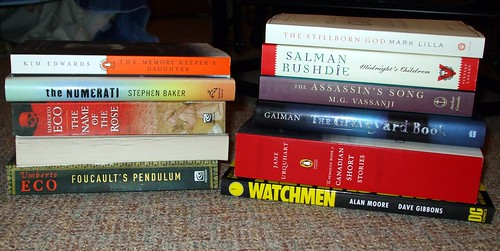
I did a terrible thing today. I bought more books.
This is how it works: Chapters is located in a mega-lot that also includes Staples, Future Shop, and Wal-Mart, any of which I may need to visit a couple of times a month to purchase stuff. However, when my body comes in proximity to Chapters, my addiction centre sends signals to my legs to move in that general direction. Once in Chapters, I am utterly at the mercy of how the sales staff has laid out their enticing displays.
The books on the left are from a previous expedition—actually, the two Umberto Eco books and Sundiver (the book I’m reading right now) came from Chapters Online. I love their shipping. The book with the spine faced away from the camera is Water for Elephants, by Sara Gruen. I forgot to turn it the proper way before I snapped this photo. Stephen Baker was interviewed in a recent episode of Spark, so I decided to purchase his book. Similarly, I bought The Stillborn God today because Mark Lilla was on Ideas.
The books on the right are from today’s expedition. My dad generously orders Chapters gift cards with his Air Miles (best use of Air Miles ever!). Thanks to him, my iRewards discount, my coupon, and some in-store discounts, I only spent $15.81 of my own money today. Thanks, dad! In addition to The Stillborn God, I couldn’t resist an anthology of over sixty short stories by Canadian authors. Another Salman Rushdie book caught my eye. The Assassin’s Song is more Indian fiction, which I‘m finding I enjoy more and more. And of course, I couldn’t buy books without getting Neil Gaiman‘s latest book, The Graveyard Book! Lastly, I purchased Watchmen to lend to people in case they were interested in reading the graphic novel before seeing the movie that’s coming out next year.
Am I addicted? Yes. Thanks to discounts and gift cards, it’s mitigated to the point where my addiction is not a problem—for now.1 Hopefully, as I get older, I will adopt a less expensive habit, like sneaking into photos of local sports teams, or compulsively stealing the 32nd page of every phone book in the city.
In fact, if you‘ve read this and are bored, why don’t you leave a comment with an idea of some truly unusual addictions? Stretch that imagination a bit!
- [ 1 ] Sort of like in House, where House admits he’s addicted to vicodin but doesn’t have a problem.
How I’ll get through this government
I have discovered how I will get through the next six months. Or year. Or two years. However long it is until Stephen Harper tries to get a majority again. I will watch CBC comedy news shows.
What would I ever do without The Rick Mercer Report or This Hour Has 22 Minutes?!
For my American friends, The Rick Mercer Report is similar to The Colbert Report. Mercer does a lot less in-studio, however, and has more clips where he goes out and meets people, politicians1, goes to schools, and gets naked.2 He has a regular photo challenge on his site where anyone can edit a photo he posts, and he’ll put them up in his gallery.
I don’t know what the American equivalent of This Hour Has 22 Minutes is. You’ve got a cast of news anchors who know no boundaries in “reporting” current events. When I was younger, I grew up on Royal Canadian Air Farce; I didn’t watch This Hour Has 22 Minutes much. However, as Air Farce declined, I started watching 22 Minutes more and more, and now I watch it exclusively. Some of their sketches are quite creative. And they are Canadian, so obviously Canadian. It’s wonderful.
There’s clips (pretty much full episodes broken down by sketch) for both the Mercer Report and 22 Minutes on their respective CBC websites. Not sure if non-Canadians can watch them, but it’s worth a try if you’re interested.
These sort of political commentary shows, in both Canada and America, can do something regular news corporations cannot: they don’t have to impartial! And that makes it so much more fun. Moreover, these comedians can poke and pry into issues that might be too sensitive or not “politically correct” enough for the evening news. Whether or not you agree with these comedians’ perspectives or laugh at their jokes, they do us a great service in a society where freedom of speech is eternally at risk.
Everything (Will Be All Right)
I shouldn’t be up this late. I’m going to bed. Really, I am. However, there is one advantage to staying up this late: infomercials.
Think what you like about infomercials. I think they’re annoying, sure. But open your mind for a moment and listen to those infomercial hosts—don’t listen to what they’re saying, but how they’re saying it. As I write this, YTV has started to air the Magic Bullet infomercial with “Mick and Mimi.” It’s probably a combination of his accent and his enthusiasm, but when I close my eyes and listen to Mick explain how the Magic Bullet is the answer to all my food-related problems (and some non-food-related ones), I can, for a brief moment, feel reassured that everything in this world is all right.
So praise the Flying Spaghetti monster for His noodly gift of infomercials. They are truly a blessing! 
The afterglow of my first election
The polls are closed, and the votes are mostly tallied. Last month, Stephen Harper called an election; this month, he was re-elected with yet anohter minority government—a stronger minority, but still a minority. In the ensuing chaotic coverage, some interesting trends have emerged. The new hot issues are Liberal leadership, government functionality, voting reform, and voter turnout.
The Liberals lost eighteen seats (at the time of this writing), which is a blow for them. Still the official opposition, yet weakened. Additionally, Dion declared in his concession speech that he would be willing to work with the Conservatives on the economic “crisis” that we’re facing. While I commend Dion for extending the olive branch, two questions come to mind: does this mean the Conservatives will have a de facto majority? And will this matter at all in a week or two when the Liberals get a new leader? For indeed, if there was anything the majority of pundits agreed that Dion is done. My opinion of Dion improved during this campaign; however, that still doesn’t mean he’s a strong leader.
The next question is: will this government be functional? Harper’s cited reason for calling the last election was that government no longer worked properly. The Conservatives have made some gains and the Liberals some losses. With a potential new Liberal leadership, will the government work together better? I’m going to be optimistic here. I predict that the government will indeed work well for at least a year, hopefully two (as the CBC panel’s predicting). There’s several reasons for this: firstly, none of the party leaders are eager for another election. I‘m ready for another one, but I don’t think it’s in Canada’s best interest right now. Secondly, although Harper has made gains, his experience with the last government will hopefully temper his attitude when it comes to cooperating. I‘m hoping he’ll play nicer with the Liberals when it comes to the economic issues on which he needs their support.
A lot of the talk on Twitter concerned reforming the electoral system. People were disgruntled with the low voter turnout. Complaints abounded regarding the new ID rules, which some people thought were the primary reason so many didn’t vote. While I don’t know about that, I can understand why the ID rules are a concern. Many are advocating reforms to the system, things like proportional representation, to mitigate the influence of parties like the Bloc Québecois, who have forty-eight seats (at the time of this writing) but only ten per cent of the vote.
As I mentioned above, I spent most of the night glued to Twitter’s search engine following some Canadian election hashtags, and I tweeted quite a bit myself. The Twitter coverage was actually much better than the coverage on television! Real reactions from real people across the entire spectrum. CBC’s TV coverage was unhelpful. Their graphics lacked relevant statistics and were uninformative. Their opinions weren’t very insightful. The CBC website was much more helpful, with an interactive map showing the current disposition of the ridings, plus very detailed statistics for each riding—I commend the CBC’s web team.
I was very disappointed with Susan Ormiston’s Ormiston online coverage of the online reaction. Ormiston displayed a remarkable lack of competence using the technology she had in the nerve centre tonight. In her defence, some of that incompetence may be due to the technology itself. From the looks of things, she wasn’t very well equipped to cull and display particular tweets or emails very nicely. It looked like some sort of hastily-created mashup in a notebook program with a couple special effects.
In addition to the poor presentation, whatever happened to actually covering the Internet reactions? At the beginning of the special coverage, they went to Ormiston, who explained how throughout the night they would refer to her for the reaction of people on Twitter, on blogs, through emails, etc. I think they referred to her a total of about three times. So much for listening to public reaction. Although the Internet is helping people have their voice heard, I don’t think that we‘re quite at the point where social media is becoming the new paradigm for politics. Not yet. Maybe in the next decade, but first we need a generation of newscasters adept at manipulating and participating in the paradigm.
Well, I have class in seven hours, so I should go to bed. To all of those who voted, no matter for whom you voted, I thank you for participating in our democratic system. To those of you who didn’t vote, I’m disappointed.
I shall close by quoting Kevin McCann tweet, which may be the best comment of the night:
U.S. friends, Canadian election is over after just 6 weeks. 60% voted left-of-centre; right-of-centre government gets in.
This New Fangled Voting Thing
OpenOffice.org 3.0 is out today, so while I was downloading the torrent, I remembered I had yet to watch Michael Moore’s free film Slacker Uprising chronicling his campaign to get slackers to vote in the 2004 American presidential election.
The film was interesting. Whatever you think of Michael Moore’s position or techniques, he’s certainly passionate about what he’s doing. And democracy may not be the most perfect system of government, but it seems to be the best one we’ve tried so far. Democracy is all about getting the people to vote, and Michael Moore was encouraging people to vote. As Martha Stewart might say, “That’s a good thing.”
Tomorrow is Election Day here in Canada. If you are a Canadian citizen and 18 years of age or older, you can vote. If you aren’t sure how to do this, go to the Elections Canada website. If you can vote, you should vote. Even if you’re going to vote Conservative (I’m not), I want you to go and vote. We live in a democracy; it is your duty as a citizen to participate in the democratic process by voting for your representative in the next government.
You don’t need to be a political junkie to vote. I wish that everyone could be an informed voter, but that isn’t a requirement either. Just go to your polling station tomorrow and vote. There’s still time to research party platforms if you really want to be informed. Otherwise, just mark a name on the ballot.
If you don’t vote, then what right do you have to complain when someone you dislike comes into power? You didn’t do anything to even try to stop it from happening. If you don’t vote, then what right do you have to complain when the government cancels a program from which you benefit or introduces legislation that affects your family? Some people don’t vote because they’re apathetic—I find this particularly true of my peers. Like it or not, however, as long as you live in Canada, the actions of the government are going to have an impact on you. If you don’t vote, you’re sending the message that you don’t care about living in a democracy.
It doesn’t take up your whole day. It doesn’t even take up an hour. If you have already voted, then good job. You’ve done your duty. You can go home, sit on the couch, and watch TV until the next election rolls around—I won’t bother you. If you haven’t voted yet, then tomorrow, go to your polling station with the proper identification, get a ballot, and make your mark. That’s all you have to do.
Addicted to inventing the future
I‘m addicted to a new game called Superstruct. It’s a “massively multiplayer” forecasting game. Sort of like a role-playing game, Superstruct is set in 2019 and concerns five “superthreats” that together weaken humanity enough to make our survival outside of the century unlikely. But you aren’t playing as a superhero or a zombie: you’re playing as you—or as you will be, in 2019.
Created by The Institute for the Future, Superstruct is more than a game. It’s a collaborative problem-solving exercise. And it’s an experiment. I learned about it from this week’s episode of Spark, where Nora Young interviews Jane McGonigal, the game designer. I was immediately intrigued. The goal of the game is to create possible solutions for the likely threats of our near future. It’s designed to be realistic. While making accurate predictions isn’t always possible, the game gives us scenarios extrapolated from humanity’s current global situation. Watch the videos for each superthreat; they sound very plausible.
As McGonigal explains, the game’s serious. It’s designed to get people to think about issues we might not otherwise consider in our daily lives. By focusing on the environment as a game, one in which people are rewarded for their efforts and participation, the IFTF is drawing upon a whole pool of people who might not otherwise provide input.
I think about the future and possible solutions to problems all the time. But I‘m not always in a position to effect change or even necessarily make my voice heard. And I love hearing the ideas of other people, not only on what the future will be like, but what we can do about it. Superstruct was made for me!
The website itself suffers from several design flaws and technical issues that make me less inclined to participate. However, I’ve joined the game, even created my own superstruct. The game only runs until November 17, at which point it will be frozen and archived for future reference. So if you‘re interested, don’t wait. Join now and start inventing a better future.
Oh, almost forgot: following the lead of other SEHIs, I also have created a Twitter account for my 2019 self.
Last updated Thursday, October 9, 2008 at 12:36 AM
My experience at a local debate
This morning I went to a debate for the candidates of Thunder Bay-Superior North (my riding). The debate was hosted by LUSU, so naturally most of it was focused on how the candidates can help students. There were plenty of questions about student loans and debts, jobs after graduation, taxes, etc. I used the debate as an opportunity to actually familiarize myself with the candidates, one of whom will represent me in Ottawa by the end of this election.
The four candidates were Brendan Hughes (Green), Bruce Hyer (NDP), Don McArthur (Liberals), and Bev Sarafin (Conservatives). Naturally I‘m biased toward the left, and this presents me with the question: if I think the Green Party or the NDP would do a better job than the Liberals, should I vote for one of those candidates instead of voting for the Liberal candidate, thus splitting the Liberal votes and enabling the Conservative to get elected?
Watching the candidates speak, I was able to get a sense of how they’d do in the House of Commons, as well as their stance on the issues. All were articulate; all tried to emphasize their personal connection to the region and their commitment to being our voice in Ottawa. Great. But what good is a voice unless it says what I want it to say on my behalf?
After opening statements and two prepared questions, the moderator (Doug West, a professor of political science at LU) opened the floor to questions. I asked the third question:
Copyright reform has received much attention since the introduction of Bill C-61. Critics of the bill point out that there has been a lack of open, public consultation and that the bill may be unenforceable without raising privacy concerns. The bill’s emphasis on technological protection measures has wide-ranging implications. For students and teachers, it may interfere with access to materials for assignments and lessons. What can you do to provide fair and balanced copyright reform?
Each candidate had two minutes to respond to the question. I was unimpressed with the responses. For the most part, I think that my question was unanticipated, especially coming from a student-focused debate. But that’s good: these people should be able to improvise on the spot. Otherwise, they’ll be eaten alive during Question Period.
- Bev Sarafin essentially said that if she gets elected, then she’ll be willing to discuss which parts of the bill (she called it “Jim Prentice’s bill”) I find dissatisfactory. Apparently she missed the day in school where we learned that you tell people how you‘re going to fix things first, then you get their vote. Not the other way around.
- Brendan Hughes was the second to respond, confessing a lack of knowledge on the bill but expressing a desire to learn more about the issue. I applaud his willingness to learn and understand that not everyone can be intimately familiar with every single issue, but it does seem like he was unprepared to answer my question.
- Don McArthur actually addressed the question, calling for provisions that enshrine fair use in law. He specifically cited that Canadians should be able to copy music from a computer or CD to an iPod (a practise that, right now, isn’t actually legal). For a two-minute response, I suppose it was fair.
- Bruce Hyer was the only one who seemed to have a prefabricated response at the ready. I’m not surprised, since the NDP has been on the ball with copyright from the beginning. However, since it was a prefabricated response, it was heavy on the NDP and light on the Hyer. He denounced Bill C-61 and praised fellow NDP member Charlie Angus, telling us to refer to his website. While it’s good that he was prepared, I would have liked to hear more than a party line.
I’m still not certain for whom I shall vote. I liked Brendan Hughes; he spoke well when it came to clarifying that the Green Party isn’t a one-issue party. They simply take the environment into account in all their policies, not just as a separate issue. I thought that was a good point. However, I don’t know if I like Elizabeth May. The more I think about it, the more Stéphane Dion seems like the best of the current choices for prime minister.
Maybe the English-language debate tonight will help me decide. Election Day is October 14. We shall see.
Ack, I’m an elitist anglophone snob
So I was going to write this entry in French, but I discovered along the way that I’ve forgotten my simple past tense. This disturbs me.
I took French from grade 1 until grade 11 in school (this was before the provincial government postponed mandatory French until grade 4). It’s only compulsory until grade 9, but I liked my teachers, and the courses were interesting and academic. Plus, being able to speak another language is a plus. Except I can’t really speak it now, can I?
Part of me thinks I don’t have an ear for languages. I excelled at reading and writing French. However, even at the height of my proficiency, I was never too hot at pronunciation or comprehension of spoken French. Nevertheless, I feel bad that I live in a bilingual country yet I only speak English. There’s this whole other culture that’s an integral part of my country’s history and current events, yet I ignore it. I feel like an elitist anglophone snob!
This week’s episode of Spark includes a segment about the French-English digital divide. That’s what got me thinking about this, although it was also tonight’s French-language debate amongst the federal party leaders. I recorded it, even though my French is rusty. Luckily I was able to catch the gist of what I watched—I didn’t watch it all, because it is rather long, and most of the issues will be covered again in Thursday’s English-langauge debate.
Of course, no amount of wanting my French to improve will magically make it improve. I‘d actually have to do something about it. My chances of doing this in my free time are virtually nil. Maybe next year, if it’s offered, I’ll take Lakehead University’s Elementary French course—it accepts my grade 11 French class as a prerequisite, and that will provide the classroom-directed motivation I need to re-engage myself in French. I guess I could also try reading for leisure in French. Maybe some Camus? I wonder if I could get my hands on Douglas Coupland in French…. :P
For those of you who speak multiple languages, what was your experience in learning languages other than your first? If you went through immersion (either in school or just by living in a different country), did you find that conducive or challenging?