What We Learned from #amazonfail
I quite enjoyed on Easter weekend watching the instantaneous outrage across the Internet, particularly #amazonfail on Twitter, as it became apparent that Amazon had removed sales rankings from books with “adult” content. The outrage stems more from the fact that the application of the “adult” label seems skewed toward books with homosexual content; the heterosexual books are safe. In the ensuing light-speed confusion: Mark R. Probst shared his limited interaction with an Amazon rep, in which the rep revealed the “adult content” policy; the LA Times book blog covers it, then covers it again when sources claim that Amazon has blamed a “glitch”; and some posited it was the result of gaming the system.
Take the time to read the above articles before reading on.
What Definitely Happened
In lieu of any definitive statement from Amazon regarding this debacle, it would be irresponsible to say, “This is what happened.” At best, we have theories. But all theories start with facts. Here are the facts, what we know did happen, even if we don’t know why it happened.
Amazon Has a Safe-Search Policy
As evidenced by Mark Probst’s post, a representative for Amazon has confirmed that there are policies in place to differentiate between “adult” and “non-adult” content and restrict the former content from appearing in some search listing. Apparently, this policy necessarily requires that adult materials have their sales ranks removed, since search listings depend, to some extent, on the sales ranking system.
Now, a search for “gay sex” quickly reveals many books, coincidentally about gay sex. So apparently that search listing isn’t affected. Visiting a listing for one of the books in that result reveals the conspicuous absence of a sales rank. Thus, while I can’t quite see how this is affecting search results, the removal of a sales rank from a book is definitely a penalty when it comes to Amazon listings.
Not All Books are Equally Adult
Craig Seymour points out that this policy isn’t new, and in fact, some adult materials have a sales rank. So at first glance, Amazon’s policy appears to be quite unfair. But having a policy isn’t the same as implementing it, and maybe Amazon’s laziness is to blame instead of its morality.
Nigerian Princes Have Taken Over Amazon
At first, the assumption across the Internet, fuelled by the likes of Probst and Seymour, was that this was all an intentional move by Amazon. Now, this is a natural reaction. Probst and Seymour’s responses from Amazon are pretty damning testimony. But it inevitably isn’t the whole story, and soon cooler heads suggested that this is the result of an exploit by spammers.
For its part, someone else at Amazon reported that this is a “glitch” they are in the process of fixing. This would seem to support those who theorize that one or more spammers have abused Amazon’s reporting system. Thus, Amazon’s adult content policy itself isn’t to blame, but rather the way they’ve implemented it: poorly.
In a previous tweet of mine, I joked that the glitch explanation implies Amazon has a “homophobe mode”, but when presented as an exploit by spammers instead of an internal problem, it makes more sense. I am more than willing to eat my words (mmm, yummy words!).
Still, the existence of this glitch raises several questions about Amazon’s responsibility to its consumers. Firstly, is the existence of an adult content policy in any way fair? If such a policy should exist, is a user-reporting mechanism really the best way to mark books as “adult”? Why doesn’t Amazon have someone manually reviewing user reports? And even if they get too many reports and have to automatically process them, shouldn’t the system be protected from common exploits?
Apparently I Need a Big Brother to Buy Books
I was very surprised to learn about Amazon’s “adult content policy,” of which I was ignorant until #amazonfail occurred. It’s not a new policy, apparently. In our haste to discuss the fallout of #amazonfail itself, it’s imperative we don’t ignore the very existence of this adult content policy and its implications for both authors and consumers.
Google has long had a “safe search” option that screens out adult content. There are two important distinctions between Google’s safe search and Amazon’s safe search. Firstly, I don’t buy stuff (directly) from Google. Secondly, I can turn off Google’s safe search.
The fact that Google’s safe search is opt-out instead of opt-in is debatable on its own, but this article is not a place for that debate. For now, since I’m using Google to find information and not to sell or buy a product, I’m of the opinion that an opt-out safe search is acceptable. If I want to expose myself to both “safe” and “unsafe” content, I can turn it off—which, for the record, I have. Unfortunately, Amazon doesn’t seem offer me the same flexibility. Not only do I fail to see an option in my account settings to disable this “safe search” of theirs, I see no mention of it. In other words, Amazon’s adult content policy isn’t a secret, but they aren’t practising full disclosure either.
This is unfair to authors who sell on Amazon, people like Craig Seymour who only find out after they contact Amazon looking for an explanation. If one wants to sell through a distributor, one expects the distributor to be up front about anything that may hinder sales, such as a restrictive adult content policy. Regardless of the cause of #amazonfail, Amazon’s adult content policy is just a bad business practice. It would be great if they would be more open about disclosing the policy’s existence and provided a feature to turn it off. It would be ideal if they scrapped the policy altogether.
We are the Patients; Amazon is Our Asylum
The speculation regarding Amazon’s “glitch” revolves around the fact that users can mark a book as featuring adult content. I can’t actually find that functionality on a listing page, but I may be incompetent or Amazon may have removed that feature as a reaction to #amazonfail. An alternative is that the system is transparent and only invoked when someone actually sends Amazon a complaint instead of clicking a button. Nevertheless, it appears that Amazon doesn’t actually base its content rating on an objective standard. Rather, it trusts its users.
Insert laughter here.
User reporting works well for small communities, or for large communities that double check the math. It is irresponsible of Amazon to rely solely on user-reported mechanisms for rating content. Even if Amazon does use such mechanisms, they should at least periodically verify that these reports are valid. It’s all too easy for a human to instruct other humans or robots to game the system. Remember how Colbert won the vote for NASA’s new module on the International Space Station? He gamed the system by getting his audience to write-in his name as a suggestion. But don’t forget that some of the other write-in suggestions were “XENU” (Scientology has its robot adherents as well) and “MYYEARBOOK” (obviously a spammer). Any automated system that allows user feedback is vulnerable to exploitation. Shame on Amazon for letting this happen, if this was in fact a glitch.
When the dust clears and Amazon releases a statement about #amazonfail, we need to walk away from this with one thing clearly in mind: while it’s unfortunate that #amazonfail happened, it’s a stark reminder of any company’s vulnerability to the masses who populate the Internet. I’m not just talking about Twitter—Twitter made #amazonfail a faster, and probably a larger, discussion, but that discussion would have happened nonetheless. And whether #amazonfail was caused by a glitch or a policy run wild or the alignment of Venus with Mars and Sedna, the fact remains that Amazon should rethink its sales ranking system. Censorship is a problem no matter what the source, and we can’t expect the spammers to spontaneously drop their weapons and surrender any time soon. So it remains Amazon’s responsibility to defend against external exploits and to craft internal policy that makes sense. As the heated reactions this Easter weekend demonstrate, that means being vigilant.
Update: Amazon has provided what is likely as good an explanation as we’ll get. I agree with Cheryl Morgan’s analysis of the entire episode.
Last updated Tuesday, April 14, 2009 at 10:33 PM
Newspapers dubbed Internet parasite by Me
According to Robert Thomson, Google is an “internet parasite”. In Thomson’s view, Google’s aggregation of content promotes a “‘mistaken perception’ that content should be free” and decreases traditional brand loyalty.
The nature of content, content creation, and how much this information is worth are at the heart of every major debate regarding the economics of the Internet. These issues are responsible for our DRM woes with regards to software and digital music, and they drive the collapse of so-called “traditional media”, such as newspapers, which aren’t adapting quickly enough to the new playing field.
This is the most amusing quotation:
Google encourages promiscuity — and shamelessly so — and therefore a significant proportion of their users don’t necessarily associate that content with the creator.
Oh no! Google’s promoting competition among content providers! How dare they?! I mean, it’s not as if the so-called “free market” is based on competition. Shame on Google for corrupting those free market values!
I would go so far as to argue that the whole point of the Internet is aggregation of content. This is why the Internet revolution is so profoundly different from any previous information revolution, including that of the printing press. The Internet removes any cost associated with distributing content—there’s only the initial cost of production, then it can be distributed an infinite number of times. And this is scary for businesses that rely on the scarcity of their commodity relative to its demand. Now that content can be ubiquitous and easily accessible, these businesses are struggling to adapt their revenue model.
Thomson’s reaction, unfortunately, is indicative of the larger trend among traditional media providers: they don’t get it. They don’t get that it doesn’t matter if content should be free—content is free now. We live in a society of moochers. Pointing at Google, which has recognized the role of the Internet in content creation and is now profiting from it, and claiming that Google’s tactics “aren’t fair” is just an economist form of whining. In order for newspapers to survive, it won’t be about the content they produce but their ability to specialize, embrace new technology—rather than resist it or co-opt it—and their willingness to share content at first in order to build that brand loyalty that Thomson insists Google is ruthlessly eradicating.
Meantime Thomson said it was “amusing” to read media blogs and comment sites, all of which traded on other people’s information.
“They are basically editorial echo chambers rather than centres of creation, and the cynicism they have about so-called traditional media is only matched by their opportunism in exploiting the quality of traditional media,” he said.
It’s true that many sites, especially those that aggregate content, aren’t necessarily original. However, Thomson fails to acknowledge that freely-available content allows for new “centres of creation.” That’s why we have concepts like “public domain” and Creative Commons.
To be fair, Thomson does a good job of summarizing the challenges of traditional media: “Thomson also said it was incumbent on content creators to make their own websites compelling for readers.” The article ends with a somewhat syntactically ambiguous quotation, but I think Thomson was adding a caveat emptor for those who prefer to reinvent the wheel rather than fix the broken one. He raises questions that newspapers must answer before finding their place in the new world order.
I for one welcome newspapers to the Internet, provided the stop whining and adapt (or die). The Internet isn’t killing newspapers; the market that the Internet facilitates is killing newspapers. And so far, newspapers‘ bids to kill off the market haven’t worked, so it’s time to face the music: change or die. Because unless newspapers do start doing something useful with their online presence, aren’t they just parasites preying on those who have been socialized—wrongly I believe—that knowledge must be hoarded?
Are You Sure This is Legal?
Today I went to renew my iRewards membership at Chapters. I took with me my gift cards from Christmas, because I know that any time I enter Chapters, I can’t leave without buying at least one book.
I bought twelve.
As usual when leaving Chapters, I experienced this giddy sensation as if I had committed some sort of crime and gotten away with it—how could they let me leave with so much knowledge?! Sure, I paid them for it, but it still seems like a crime. Buying books leaves me exhilarated—I don’t know why people do drugs when they can just get high off reading. At least, I find reading that enjoyable; I suppose other people don‘t.
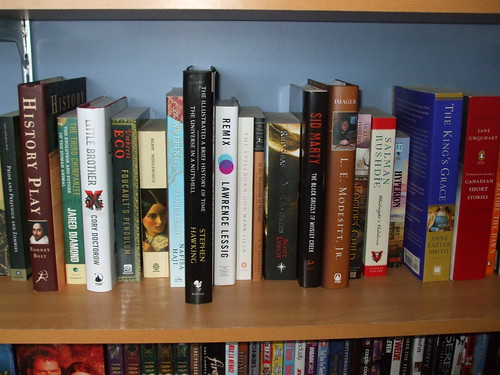
The photo above includes books I acquired prior to today as well, including some older editions of Sense and Sensibility and Middlemarch, which I got for free. Highlights from today’s trip include Remix, by Lawrence Lessig, Pride and Prejudice and Zombies, by Jane Austen and Seth Grahame-Smith, and Before the Dawn, by Nicolas Wade.
I‘m looking forward to reading all of these, as well as the nine books I borrowed from the library today. This is how I intend to spend my break.
Now excuse me while I go into hiding, because I can’t believe I got away with this.