Think This, Say That, Wear Your Flag
I woke up this morning to the following headline in my RSS feeds, courtesy of CBC News: N.B. school silences O Canada. It already had 249 comments then; it’s up to 658 comments as I’m writing this. CBC News has since updated the article to expand its content and provide a more detailed story; the original article was less informative, which didn’t stop people from commenting on it.
In case I haven’t been clear in the past, let me first establish that I don’t believe in being “politically correct”. What’s the point in living in a free country if you have to walk on eggshells just to avoid offending anyone? To that end, it’s Merry Christmas and not Happy Holidays. You can say BCE or BC; I don’t care—it’s still inherently based on Christianity, so it isn’t “politically correct”—just annoying.
But I digress.
My initial reaction to the article was, “Well, this is stupid.” This was just another example of the politically correct movement going too far! There’s nothing wrong with singing the national anthem! Back in my day (I can’t believe it’s been two years already), I sang the national anthem aloud every morning at school—and I can’t sing, so I can only imagine what torture it was for my classmates. I still sing at baseball games. To me, singing the national anthem is appropriate at school and at sporting events. After all, I had been singing it ever since I was a ki—
That’s the point where, after reading the comments on the CBC article from people on both sides of the issues, I recognized that I was running up against a barrier of my own indoctrination. It’s true: I sing the national anthem because that’s what I was taught to do.
And if there’s anything I dislike more than the politically correct movement, it’s nationalism. Ick. Although I recognize that in some circumstances, nationalism is useful, it mostly just leads to trouble. We’ve all learned about the first two World Wars, correct? Good. I rest my case. Before I go on, however, I’ll mention that I consider nationalism and national pride to be two different but closely related concepts. Nationalism is national pride taken to the extreme; it’s socially-enforced national pride. I have no problem with people being proud of Canada; I’m mostly proud of Canada.1 It’s when that pride motivates Acts of Stupidity that we need to take a step back and ask if what we’re doing makes sense.
Suddenly an issue like singing the national anthem in school no longer seems so simple. I can see arguments for both sides. On one hand, it’s stupid to remove this activity because a few students don’t want to participate. No one’s forcing students to sing the anthem. On the other hand, what does singing the anthem mean? Is it really required in school, or is it an unnecessary component of the indoctrination of children into Canadian society?
It’s hard to cast off the shackles of one’s own indoctrination. Not everyone succeeds.2 Breaking free of indoctrination doesn’t mean rejecting indoctrinated values, although many see it that way. Instead, it means one has to examine one’s beliefs critically and look at alternative points of view to decide if those make more sense.
You Can’t Define With a Negative
It’s impossible to do justice to the subject of Canadian identity in this blog post. Better scholars than I have written books on this subject, so I won’t even pretend to be adequate at defining what’s Canadian. Nevertheless, we need a definition, something mildly more substantial than “not American”.
One commenter on the CBC article, jtbrown, said:
I think that people are missing the point that Canada is exactly the kind of country where it is okay to have this kind of opinion…. In Canada we are free to question the actions of government, to voice dissenting opinions, to stand up for the rights of minorities and to think and speak freely without the fear of reprisals, except, that is, from some outraged,blindly patriotic bloggers.
So rather than defining “Canadian” as who we are, let’s define it as what we can do—is not action better than mere existence? Thus, to be Canadian is to have the freedom to express one’s own opinions, as well as the ability to choose to respect the opinions of others, without being fettered by social or religious mores.
I Can Haz Anthemz Now???
Canada has always been ambivalent about nationalism, to the point of having multiple dates one could celebrate as Canada’s independence—1867, 1931, 1982. We didn’t have a our maple leaf flag until 1965. And as Americans are quick to remind us (to be fair, we‘re quick to remind them, with perhaps even more smugness), we didn’t fight for our independence—we asked nicely.3
Our national anthem, O Canada, became official in 1980. There’s actually two sets of lyrics—one English, and one French, in keeping with our bilingual society. The English lyrics have come under fire from secularists (for including the word “God”) and feminists (for the word “sons”). I’m not sure if the French lyrics have ever been criticized. They seem less controversial, although I could see “forefathers” upsetting the feminists, I suppose, and that whole thing about wielding a sword might anger pacifists4
For the record, I don’t believe in any particular God, but I don’t mind that our anthem has “God” in it. It’s not a big deal for me.
I like this comment by “middle Perspective”:
Learning and practicing our National Anthem keeps Canadian’s bound together on a national level. Our communities are all very different, and if we derived what we are from them (like you said), we certainly would not all be Canadian (e.g. Quebec, Newfoundland, Alberta). But with a national anthem, its a tool in which we all know what we mean to other communities and united on an international stage.
Most of us would agree that the anthem serves as a tool for promoting nationalism; that much is obvious. But if being Canadian involves respecting the diversity of others, even if they don’t agree with you, how does this affect the purpose of our national anthem?
“RrrPla” has a very specific idea about the role of the anthem:
Our national anthem is as intrinsic to our citizenship as is our right to vote, our freedom of conscience and right to live in peace. Canadian loyalty is not optional. It is mandatory, and symbols of our country such as the flag and anthem are not negotiable.
I‘m glad I don’t live in the same Canada as RrrPla. The idea of “mandatory nationalism” sounds vaguely like “militaristic nationalism” or even “national socialism”, and we all know how well that turned out.
Finally, Aaron A says:
There is nothing more Canadian in this country than its anthem, not playing it in schools is no different than refusing to fly the flag, and is tantamount treason. How this principal could side with a few unpatriotic parents over his country is appauling. If they don’t like the anthem, then they should live somewhere else!!!
I will agree that refusing to sing the anthem is unpatriotic, sure. But Aaron seems to equate being unpatriotic with treason, and that’s a rather large jump. Some people refuse to sing the national anthem due to their religious or personal beliefs—some religions forbid their followers from espousing loyalty to any other authority, and maybe a more ardent anti-nationalist than myself would refuse to sing the anthem due to its nationalistic purpose. These actions are unpatriotic, but that doesn’t make them wrong, bad, or treasonous. Furthermore, people who refuse to sing the national anthem can be patriotic or show national pride in other ways.
Our national anthem, then, evokes national pride and is a tool for promoting nationalism when Canadians need it most. It doesn’t seek to assimiliate the diversity of Canada’s cultures and force everyone to think or believe the same thing. It does encourage Canadians—all Canadians—to feel proud of the entire country.
Please, Think of the Children!
Yes or no: should all public schools in Canada play the national anthem at the beginning of each day, during which time students may sing if it pleases them, although singing is not required?
There is a difference between just playing the national anthem and singing it. Honestly, how many kids actually sing the anthem? When I was in high school, we didn’t sing the national anthem.5 It played out over the intercom, often in this bizarre technobeat that was a travesty of anthem. We would stand at attention, have a brief moment of silence afterward, then sit down and start chatting with each other. We‘d have to talk very loudly, of course, because there were announcements playing out of the intercom that threatened to drown out our important conversations.
But I digress.
Listening to someone play the national anthem is a more passive activity than singing it. It’s very hard not to listen, since you’d have to block your ears.6 Singing, on the other hand, implies you want to celebrate the national anthem.
With that in mind, my answer to the opening question for this section would be “Yes.” Public schools are supposed to educate children about Canada, and that includes the anthem. There’s nothing wrong with playing that anthem.
But what about having kids sing it? Here’s a few more comments I selected from the CBC article.
“Pinpatch” thinks we should all love one another but wants you to get “flack” if you don’t sing the national anthem:
I think it is so sad that there are so many people on here who think it is OK NOT to sing the national anthem. Part of living in this country is singing your anthem, and everyone should not only know how to sing it, but BE PROUD OF IT! I dont know what is wrong with our country,,,,, The US is very patriotic, and its a shame that we are not like that, no one seens to give a damn about our country anymore, when we have so much to be thankful and grateful for here. Stand on guard for your country, support our country, support our troops… love one another . freedom…. Thats what our anthem represents.
Rick Thibodeau’s particularly vocal in this discussion. As a local, he managed to put provide some perspective for the commenters who were blaming immigrants for this issue:
I think you guys are missing a big point; many of you believe it’s some immigration issue…last time I was in Belleisle, specifically around Hatfield point, Kars, Wickam, Norton, I didn’t see many immigrants, if ANY at all, waving their own flags around inciting some speech to reform school systems to include them. If anything, most of the population that exists there are pentecost and baptist…so WHO exactly are the ones taking down the anthem? Certainly not a dozen people…
Lastly, “Western Opinion” has a sardonic observation of a trend he or she has espied:
Yet another accommodation so as to not offend the very few.
Next on the list…..banning the use of red ink and x’s when evaluating student’s work or emphasizing the use of handwriting by the teacher because 1 student in the class can’t or refuses to learn how to read it.
This country is going in the toilet.
Thus I Take Refuge in Apathy
This article has certainly attracted discussion and comments from people on both side of the issue. At first I agreed with those who thought this all a bunch of politically correct nonsense. Then I agreed with those who thought this all a ploy by nationalists to further indoctrinate our children. Then I realized I had no clue what to think, and that I’m very, very confused.
So sing the anthem, don’t sing the anthem—ça m’est égal.7 We have better things to do in this country than debate about whether or not it’s good to recite a bunch of epideitic words at the beginning of each day. We still have no good leadership, a budget that will either fix all our worries or damn our economy once and for all, and Sarah Palin is gearing up her election machine for 2012!!8
Ideally I’d preserve the status quo—keep public schools playing the anthem, don’t force kids to sing it unless they want to sing. Offer some of those nifty noise-cancellation headphones for the kids whose parents don’t want them listening to it.
Oh, and for all those people who left comments on that CBC article to the effect of “if you don’t want to sing our anthem, you should get out of Canada”, shame on you. Such an opinion is not Canadian, and while I respect your right to voice it, I don’t agree with it, and it doesn’t improve my estimation of you. In this country, we‘re allowed to disagree with each other, but we should be civil about it. Just because our Members of Parliament fling insults at each other doesn’t mean we should. We are better than that.
In conclusion, Carthage must be destroyed.
- [ 1 ] Except for the parts currently occupied by Stephen Harper
- [ 2 ] Those who fail go on to lead successful lives at Fox News.
- [ 3 ] It helped that, by that time, Britain was pretty sick of us and was happy to dump us for India.
- [ 4 ] Which would result in a very sternly worded letter, I’m sure.
- [ 5 ] Except, as previously noted, I did, much to the regret of my classmates.
- [ 6 ] So if an anthem plays in a forest, and no one is around to hear it, is it still patriotic?
- [ 7 ] No, I’m not telling you what it means. Google it.
- [ 8 ] Breathe, Ben. It’s four years away. Plenty could happen before then. Her daughter could have another unexpected teenage pregnancy. We can only hope.
How NOT to microwave butter
Note to self: when melting butter in the microwave to use over popcorn, do NOT set microwave to high.
Luckily, our microwave is from 1987 and thus built like a tank. In order to destroy it, you‘d actually have to stick a smaller microwave inside it and activate the two simultaneously. This would, of course, tear a hole in the space-time continuum, destroying the universe as well as the microwave. So don’t try it.
Here’s a close-up of the carnage:
More narcissism and a little about you
Sometime between November and … now … it became now. I’m not quite sure when this happened, or how it happened1 … but it happened. Now that it’s now and no longer then, that which was must become what was going to be when then became now—which is now.
In that same spirit, the university felt it right and proper to commence a second term of classes following on the heels of the first term. I have six courses this term, three math courses, two philosophy courses, and an English course masquerading under the horribly ambiguous name of “Advanced Rhetoric.”
Two of my math courses, Linear Algebra II and Group Theory, are continuations of two of the courses I took last term. Linear Algebra II is, unsurprisingly, the conclusion to Linear Algebra I. We‘re learning about eigenvalues, eigenvectors, and diagonalization. I’m finding this course easier than the first part, in which I struggled somewhat. Group Theory and Ring Theory are related areas of abstract algebra. “Group theory” always sounds to me like some sort of bizarre sociological phenomenon, but I assure you, it’s a math course—complete with dusty chalkboard, incomprehensible symbols, and theorems named after dead white guys.
The third math course is Vector Calculus, which appears to be the answer to the question, “What happens when you design an art course for mathematicians?”2 Not only do we learn about parametric equations, polar curves, vectors, lines, and planes—we get to draw them too! I signed up to write down incomprehensible symbols, not draw them! :P
I’m taking both Logic and Critical Thinking, which complement each other nicely. Logic also comes in handy with math, and my background in math means the symbolic aspect of the course is easy.
Also complementary to logic is rhetoric, embodied in my “Advanced Rhetoric” course. The name is ambiguous because the particular topic is left to the professor. This year, the prof teaching the course specializes in classical rhetoric, so that’s what we’re learning. We’re starting with the ancient Greek and Roman philosophers and rhetoricians, particularly Aristotle3 In keeping with the course material, all of our assignments come from the progymnasmata, which is a sequence of fourteen assignments that students would begin at a young age and complete throughout their education. We’re doing a fable, a refutation, an encomium, and an argument. Additionally, we have to keep a “commonplace book.” At the beginning of every class, the prof dictates passages from a book of his choice—we‘ve done Virgil’s Aeneid, Tacitus’ Agricola, and even some I Corinthians. One of the not-so-secret consequences of this exercise will be an improvement in our ability to take down dictation, an ability that was integral to students in ancient Greece and has significantly lapsed since the 19th century.
Edit: Forgot to add my favourite quotation so far from my rhetoric prof:
Aristotle loved to classify things. A platypus would have really messed him up.
Win.
But that’s enough about me. Let’s talk about you for a moment. Did you know that you may just be a hologram? No? But wait, there’s more! The entire universe may just be a hologram. How unbelievably awesome yet intensely weird is that?
Hoping, as always, to post more regularly—I have some interesting ideas! I just need to find a good, routine spot in my weekly schedule where I can write blog posts.
- [ 1 ] If you know, please do explain it to me.
- [ 2 ] The real answer should be: DON’T.
- [ 3 ] He wrote an entire book called Rhetoric, dontcha know!
Last updated Friday, January 23, 2009 at 7:27 PM
Further evidence that I lack common sense
We all have humbling experiences that remind us we aren’t as smart as we think we are. And even if we are that smart, sometimes we still lack common sense, and other times we just plain don’t think.
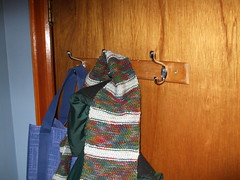
A couple of days ago, I woke up to the a slow but inexorable cracking noise coming from the vicinity of my bedroom door. Sometimes my cat scratches at my door in order to gain entry, oblivious as to my current state of consciousness. This sound wasn’t like a cat scratching, however, which was why I had trouble placing it at first. Unlike the frantic scrabbling noise of claw on wood, this had the deliberate sound of something going horribly, horribly wrong.
Several seconds later, the sight of the hooks on the back of my door falling out, taking my coat with them, confirmed this fear.
I had stupidly placed my library book bag on these hooks. When the bag is empty, this isn’t a problem. Yet as I gradually fill up the bag with each book I read, it becomes heavier, adding strain to the hooks.
My brother originally installed the hooks; he was also the one who affixed them to that dandy little wooden plank. Since I‘m inept at anything involving tools, I had my brother put the hooks back up. This time, I had him add anchors, which he didn’t use the first time around.
Of course, I won’t be putting my book bag on there ever again….
Speaking of books, here is a photo of my brand new shelving:
As you can see, I have much more room to grow as my book collection expands. My DVDs may soon need to usurp part of another shelf as well, unless I find an alternative storage area. The second shelf from the bottom provides a handy spot to house books I intend to read (they previously squatted on the floor and played poker while I wasn’t looking). On the left are library books—currently empty, since I’m reading my last one right now—and books I’ve bought are on the right. A LOTR boxset—touted by Metheun publications as an “authorized Canadian edition of the heroic tale”1 separates these two categories. The boxset originally belonged to my dad, but I “borrowed” it sometime in grade five or grade six to read, and I just never gave it back. Muwahahaha. One of these days I need to repair the binding on the first volume….
But I digress! To answer the question that is burning in your mind at this point: yes, that is an inflatable crayon. I‘ve had it for years, but never has it looked more at home than as a finishing touch on my shelves.
And that’s it for this week’s edition of “Ben has no common sense, but look at all his pretty books.” Next week: why we don’t run with power tools!2
Top 10 best and worst books I read in 2008
I had originally intended to eschew the “best of 2008” and “worst of 2008” trend that always appears at the end of the year.1 However, one of the best websites I discovered in 2008 was Goodreads. Since joining in May, I can’t recommend it enough. A self-proclaimed bibliophile, much of my leisure time goes toward reading. Thanks to a terrible memory, I have trouble recalling the particulars of books I’ve read; my reviews usually emerge as hazy generalizations that make me feel like I didn’t read the book at all. Continuing my trend of using technology to replace my memory, Goodreads helps me organize my books; I can keep track not only of books I‘ve read, but I also add books I want to read. It’s pretty much awesome.
So I thought, since I can actually remember what books I read this year, why not post a top 10 list of the best and worst books I read in 2008? Technically, this is “best and worst since May 2008”, since that’s when I started using Goodreads. Even so, I had trouble paring down each list to only ten books—I can only imagine it’ll be more difficult to do next year when I have twelve months’ worth of books from which to choose.
Top 10 Best Books I Read in 2008
10. The Memory Keeper’s Daughter, by Kim Edwards
From my review:
This is a story of curdled bitterness. One of the main characters tears his family in two and creates a gaping wound that doesn’t heal until several decades later. A tale of “twins separated at birth”, The Memory Keeper’s Daughter explores how the secret complications of that separation affect all the members of the two families that raise these twins….
9. The Name of the Rose, by Umberto Eco
My review contains spoilers, so read it at your own risk:
It took me a long time to finish this book (perhaps the longest time it’s ever taken me to read a book). Umberto Eco sets out not just to provide another pulp fiction fodder for the masses, but to construct a richly-textured story—or rather, history—with elements of mystery, rhetoric, and religion. As a result of the book’s depth, not to mention its lengthy passages of medieval rhetoric, I started this in October and am only now finishing it; I read other books on the side to keep myself occupied. But the length of time it takes me to read a book is irrelevant, as long as I enjoy it. And that I did….
8. The Monsters of Templeton, by Lauren Groff
Judging from the other reviews, this is one of those books where you either love it or hate it, for the exact same reasons. Where I see wonderful voice and interesting plot, others see purple prose and pretentious fiction. And that’s fine.
First I read this book with curiosity and, I confess, not a little scepticism. Then I read this book with pleasure and even, perhaps, morbid anticipation. Finally, as I turned the last few pages and the book spoke to me of endings and new beginnings, I read this book with appreciation and wonder….
7. Small Favor, by Jim Butcher
The tenth book in Butcher’s bestselling Dresden Files series brings us yet another cover that showcases Harry Dresden in his trademark duster, hat, toting his trusty staff. From my review:
This may be the best Dresden Files book yet….
The blending of mystery with urban fantasy is tangible and potent. Few can do it so well. This novel is great in that respect, because urban fantasy lovers can read it and get exposed to a little mystery they might otherwise ignore; mystery lovers likewise get some urban fantasy. Yet Butcher remembers the golden rule of genre writing: the genre is a setting, not a story. This book is not about faeries, or wizards, or magic, or solving a crime. It is an action adventure with motifs of temptation, redemption, suffering, and all that makes us human. It’s a story, set in a world of faerie, magic, and crime. What’s not to like?
6. Wizards: Magical Tales from the Masters of Modern Fantasy, edited by Gardner R. Dozois
Anthologies are a great way to discover new authors. I picked this one up because it had stories by favourite authors like Neil Gaiman and Orson Scott Card. Along the way, I’ve come up with a few new names I can explore.
5. Dreamsongs: Short Works (Volume 1), by George R.R. Martin
What a great way to tide us over until Martin gets around to finishing the next book in his epic A Song of Ice and Fire saga. Whether you‘re new to Martin’s work or a fan, like me, you’ll enjoy this large and varied collection of his earlier short fiction.
Martin is brave to publish Dreamsongs, which gives us—especially those of us who are younger readers and haven’t been as exposed to the short fiction magazines of Martin’s youth—a glimpse of Martin’s formative years and the works with which he became a professional author. You can clearly see his writing improve over the course of the five-part book. Yet at the same time, even his early stories carry the kernel of creativity that’s evident throughout this volume….
4. Shake Hands with the Devil: The Failure of Humanity with Rwanda, by Roméo Dallaire
One of those books that every Canadian should read, this tells the chilling story of the Rwandan genocide from the perspective of the UN task force commander, Roméo Dallaire.
Daillaire’s book is commendable because even though it comes from an obviously biased source, it largely avoids obsessing over assigning blame. Instead, he chronicles what happened during tenure as Force Commander of UNAMIR. Thanks to him, future generations have a testimony as to what happened in Rwanda. Eyewitness accounts help make clear what government reports and newspaper articles cannot; they communicate the human experience one undergoes in these situations. They remind us that this isn’t fiction, so it isn’t a tragedy. It is truth, but it is injustice….
3. Lullabies for Little Criminals, by Heather O’Neill
From my review:
About two hundred pages into the book, I suddenly realized that this story was breaking my heart….
The theme that resonates with me most is that childhood is the most precious innocence we have. Baby makes several philosophical remarks about childhood, how society encourages us to grow up too fast—and the fact that we can’t go back afterward. We’re stuck as adults. As an 18-year-old, I‘ve reached the legal age for adulthood. I’m venturing into that scary world of responsibility; no one treats me as a child anymore. I have the advantage of never experiencing Baby’s hardships, yet I still feel confused at times. Everyone probably does, which is why this book captures your heart….
2. I Love You, Beth Cooper, by Larry Doyle
This book was just fun to read. Yeah, it’s yet-another-book-about-adolesence, but it’s a witty one:
I Love You, Beth Cooper could be, at first glance, a typical coming-of-age story about the nerdy smart guy who falls for the popular cheerleader (or for his construction of who the popular cheerleader is). To some extent, it is such a story. But it’s not only such a story, and that isn’t the aspect of this story that makes it awesome. Rather, it’s the fact that in spite of employing such a major trope, the story is never trite, and it never tries to force a redeeming theme on the reader. Instead, anything and everything that could possibly go wrong for the protagonist does. And when things go right, they don’t always go right in the way one would expect….
1. Unaccustomed Earth, by Jhumpa Lahiri
From my review:
I went into this book not knowing what to expect, and I loved it. Jhumpa Lahiri creates timeless families that straddle the cultural divide between America and India. She captures the conflict of growing up as one tries to balance one’s parent’s wishes with the influence of one’s heritage and the culture of one’s surroundings.
Of the first part of the book, I loved “Unaccustomed Earth”, “Hell-Heaven”, and “Only Goodness.” The other two stories were great, but …more I went into this book not knowing what to expect, and I loved it. Jhumpa Lahiri creates timeless families that straddle the cultural divide between America and India. She captures the conflict of growing up as one tries to balance one’s parent’s wishes with the influence of one’s heritage and the culture of one’s surroundings….
Shortlist for the Best
Some books that made the shortlist, in no particular order:
- The Lies of Locke Lamora, by Scott Lynch
- The Ravine, by Paul Quarrington
- House of Suns, by Alastair Reynolds
- Roma: The Novel of Ancient Rome, by Steven Saylor
- The Pillars of the Earth, by Ken Follett
- The Age of American Unreason, by Susan Jacoby
Top 10 Worst Books I Read in 2008
10. Lavinia, by Ursula K. Le Guin
This may come as a surprise to those who know that I love Le Guin’s other work, or for those familiar with Le Guin’s other work—she’s a pretty big name in fantasy and feminist fiction. Unfortunately, I couldn’t give Lavinia any more than two stars. It was enjoyable, but not great:
…in places the narrative was somewhat dry, so while the setting and characters were interesting, the story was not always so. Some people might not like the narrative style either—there is very little dialogue, except in Lavinia’s conversations with Vergil. Instead, it is told in an almost stream-of-consciousness perspective, with Lavinia relaying back her interpretation of the other characters’ thoughts and actions….
9. The Sword of Truth series, by Terry Goodkind
My coworker lent each of these consecutively to me during the summer; it was sort of a “summer reading project.” Goodkind, a fantasist who insists he’s not a fantasist, crafted an 11-book series in an alternative world concerning the ultimate battle of good versus evil. Oh, and there’s lots of rape.
My advice is that you should read this series, actually—or at least the first few books. Why? Because then you’ll have more fun when you read the parodies of it, of course!
8. Beginner’s Greek, by James Collins
Actually an OK book, if you don’t mind this genre. I expect it will be a movie soon. From my review:
As with most plots of this nature, I found it utterly predictable. Certain aspects were surprising, of course—I didn’t see the best friend dying by a lightning strike on Peter’s wedding day, of course. But it was clear that Peter and Holly would end up together, somehow, and that everyone would live happily ever after. If you‘re looking for a fresh new plot with compelling characters, you won’t get it here. Oh, the characters are interesting, and you’ll end up hating most of them by the end. But you have to be able to stomach the smugness that the book exudes as all the threads come together and the loose ends get tied up.
It was OK. Enjoyable light reading, and it fulfilled my need to yell at the book when characters are being stupid and cheer when good things happen.
7. The Uses of Enchantment, by Heidi Julavits
This story was a disappointment. Julavits has fantastic style, but the plot and the characters were substandard. From my review:
I empathize with Mary, who was either abducted and never properly counselled about it or engineered a fake abduction and never adjusted properly to society. But she spends most of the books complaining about how manipulative and narcissistic her mother was, and how she never got a chance to reconcile with her mother prior to her mother’s death from cancer. Although the story spends a lot of time discussing therapy and Mary’s experience with it, Mary never seems to have to exert much effort in her life or deal with any consequences (beyond her obvious estrangement from her family). She crashes a car, revisits the ghosts from her past, but at the end of the book, has she really changed from who she was at the beginning? No. And that was a disappointment.
6. Blasphemy, by Douglas Preston
A predictable mystery with a sci-fi twist, it was fine for formula fiction, but I could have done with something more satisfying.
5. Overture, by Yael Goldstein
Four words: “torrid but virginal liason”. Need I say more?2 If that intrigues you, you might like this book. If, like me, that would cause you to snap and perhaps evacuate the contents of your stomach, don‘t read this book. Because you need a stomach for plot-twisting romance, which is something I don’t have.
4. What I Was, by Meg Rosoff
This book was the origin of the “not my cup of tea” shelf on my Goodreads profile, I believe. It’s an example of how THE TWIST can ruin an otherwise acceptable book. From my review:
The first part of the book was quite intriguing. The narrator is a noncomformist boy who’s been expelled twice; this is literally the boarding school of last resort. Then he discovers a friend in the form of a boy living alone in a house on an island near the school, and the two form a tentative relationship laced with overtones of homosexuality—which is just what Rosoff wants before she pulls THE TWIST that changes everything.
Unfortunately, after THE TWIST, the book isn’t the same. It rapidly becomes a “hindsight is 20/20” sermon in which the main character regrets that he has no regrets and ultimately has not made much of his life. We are left with no resolution. It’s quite postmodernist….
3. The Last Theorem, by Arthur C. Clarke and Frederik Pohl
As with Le Guin, I’m sad to say that Arthur C. Clarke earns a spot on this list—and at number 3! Since I don’t know how much of the book is actually Clarke’s, however, that somewhat mitigates my pain. From my review:
My major problem with the book is the lack of any consequences, or really, any conflict at all. At points the story threatens to inject a conflict—such as when Ranjit becomes an unwitting accomplice to pirates and subsequently spends two years being tortured in prison. For a moment, I thought that might produce some genuine unhappiness that could mar this otherwise oppressively upbeat book. Unfortunately, that was not the case….
2. The Abstinence Teacher, by Tom Perrotta
I didn’t buy this book when I was tempted to at Chapters, and I’m glad of that. I read it after my dad borrowed it from the library; I almost couldn’t finish it. From my review:
The Abstinence Teacher begins by introducing us to Ruth, a divorced mom who’s the sexual education teacher at the high school in this small, conservative town. She’s under siege at school for wanting to teach safe sex instead of just abstinence. Meanwhile, she picks fights with her younger daughter’s soccer coach, a born-again evangelical Christian, for leading the team in a prayer after a game. And she neglects her older daughter, which drives that daughter to seek meaning through—you guessed it—Christianity. Oh, and she wants to find a man. And she’s friends with a gay couple.
I’m not making this up.
See, that’s my problem with this novel: it’s too contrived. I say too contrived because I realize that most novels, especially ones with overt thematic agendas like this one, need to be contrived to an extent. Perrotta has gone further than that, however, because he weaves sexuality into every aspect of the book and uses stereotypes like “the gay couple” to advance his theme. Others may not have a problem with this, but I found it awkward and artificial….
1. The Art Thief, by Noah Charney
For the love of whatever deity(ies) you worship, or don’t worship, DO NOT READ THIS BOOK. EVER.
This is an example of a book that isn’t anyone‘s cup of tea. Noah Charney’s career in art history is obvious in this book, since he spends so much time lecturing us about art history, at the expense of the plot. Ostensibly a mystery, whenever that story threatens to become interesting, Charney beats it back into submission with a baseball bat and resumes showing us how brilliant he is.
Blech.
Shortlist for the Worst
None of these books made it on the list because I disliked all of them, but they aren’t very bad books. As such, while they weren’t to my taste, if you think you’ll enjoy them, you could do worse than these:3
- The Book of Lies, by Brad Meltzer
- Nightshade, by Paul Doherty
- The Society of S, by Susan Hubbard4
- Mistress of the Sun, by Sandra Gulland
One Last Plug
And in case I haven’t linked to Goodreads enough for one blog post, here’s my profile so you can stalk me. If you’re on Goodreads, feel free to add me as a friend. If you‘re not, and you like reading, why aren’t you?!
That’s it for the best and worst books I read in 2008. It was fun, no? Come back in 363 days or so, and we’ll do this all over again.
- [ 1 ] I still intend to avoid resolutions.
- [ 2 ] If I do, check out the review.
- [ 3 ] You could read one of the books that actually made the list, for instance.
- [ 4 ] I am sooo over vampire novels.