
Review of Stargate: Continuum
I woke up today and went to Future Shop to buy Stargate: Continuum, although I couldn’t actually watch it until after work tonight. It was worth the wait.
I admit that I feared Continuum would be a “Well, let’s turn ‘Moebius’ into a movie.” Yet another time travel episode. Yes, there were similarities—it’s time travel, after all, with alternate timelines and whatnot—but this movie really captures the Stargate genre and provides the essential link between the old Stargate SG-1 series and (hopefully) the future movies to come.
The story is largely self-contained, due to the nature of the time travel. By the end, nothing in the Stargate universe has really advanced, with the exception of the execution of Ba‘al. That doesn’t stop it from being an excellent story, and the characters make it that way. Richard Dean Anderson’s “special guest appearance” brought O’Neill back into the mix. I would have liked more of him, but what little screen time he had was well used. The other members of SG-1 were awesome. Teal’c managed to pull off yet another convincing Heel Face Turn. Michael Shanks has a fun scene where he talks to the alternate timeline version of himself on a phone—we only see our Daniel Jackson and the phone and hear one side of the conversation.
Ba‘al is such a fun, classic Stargate villain. He really embodies what makes Stargate venerable: it doesn’t take itself too seriously. It has fun. Ba’al is your classic evil overlord who tosses off his gloating “last lines” and claims he can never be defeated (those of you familiar with the series may recall that he came close to fulfilling that claim once and a while). Cliff Simon portrays him in exactly that way: moustache-twirling bad guy who’s trying to see his latest evil scheme to fruition.
The effects are cool. The best effects, however, come from the non-visual effects. Some of the cast and crew went up to the Arctic and shot there, which is cool enough by itself. But the navy actually let them use the USS Alexandria, a nuclear-powered submarine. So we’ve been watching Carter and Mitchell trek across the frozen Arctic ocean, they meet up with their rescuers, and suddenly we see this submarine—a real U.S. navy submarine—surface through the ice. It is amazing. We also get to see it submerge again, and then the real crew of the submarine appears as themselves. You can tell that they are a bit nervous about appearing on camera. If you watch some of the special features, particularly “Stargate Goes to the Arctic”, you’ll learn how difficult some of those shots were to obtain. We also get to see some nice close-ups of real F-15s. The Air Force and Navy have been very good to the show. :P
The special features are great. I haven’t watched the commentary yet, but “Stargate Goes to the Arctic” shows you how those who went to the arctic lived and filmed. “The Making of Stargate Continuum” is interesting. “The Layman’s Guide to Time Travel” will be interesting if you want to learn more about time travel. 
Stargate Continuum remains true to what Stargate SG-1 has been for ten years; existing fans will be pleased. Unlike The Ark of Truth, which served to tie up an existing storyline, Continuum will be a pleasant introduction to the series for new fans, mostly because of its self-contained nature. Those familiar with the series are going to have a grand time watching the various references from the past ten years of the show. I snickered several times when I noticed something that I recognized from another story. New fans will get to see the cast of SG-1 at their best and some great action.
The hypocrisy of age ratings
Let me begin by saying that I don’t support age rating of books (i.e., saying “this is for ages 8-12, this is for young adults, this is for adults…”). However, when you look at how we rate our other content by age, it seems hypocritical, does it not?
Games and movies receive official ratings that state whether or not the content of those products is suitable for a certain audience. Sometimes, the law enforces these ratings. That means if you’re under 18, you can’t get into an R-rated movie (without an adult). But you can go and buy a book that may have the same graphic scenes as an R-rated movie, and the cashier at the store doesn’t stop you. They don’t card you. (At least, they didn’t card me when I was under 18.)
Seems like we have a double standard here. I know, I know: books aren’t as “visual” as movies or games. Reading about mass violence or sexuality, reading a curse word, that isn’t the same as seeing and hearing it. Well I think that insults the average reader’s imagination. And even if it doesn’t compare to graphical depictions, wouldn’t a book’s descriptions, if done well enough, still be specific enough to scar immature readers? Should we continue to let unrated books be sold?! Where are you torches and pitchforks, people?
Luckily, since most children and young adults these days aren’t interested in reading for pleasure, we don’t have to worry about this crisis. 
It’s all fun and games until your death ray explodes
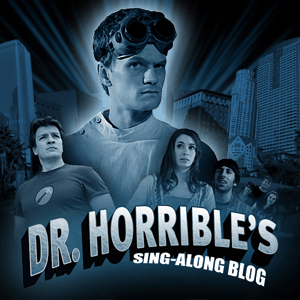
Act three of Dr. Horrible’s Sing-Along Blog is up. You can watch all three acts until midnight July 20. Go do it. Right now.
I‘ve got mixed feelings about act three. As I write this, it’s only been up for about an hour and a half, so fan reaction is still formulating. A lot of people are angry. I can see how act three seems like a let down after the first two acts. Now, this may just be major denial on my part, but I think Joss planned it that way.
A supervillain musical isn’t something you see every day. Instead of casting Dr. Horrible as the straight antagonist and villain, he has made him a villainous protagonist. We actually root for him; we want him to get the girl. But having him succeed in his evil plans and getting the girl would blow our suspension of disbelief out of the water—Penny’s character doesn’t allow that. So the ending is the only natural way for the plot to conclude (if it is a conclusion).
The saddest scene for me, however, was not the one at the climax after the explosion of the death ray causes you-know-what (if you don’t know what, I won’t spoil it for you—go watch!). Instead, it was when Penny was sitting in the laundromat, with two frozen yogurts … alone. It just said so much. She missed Billy too. She had come to enjoy his companionship. Later, we get the sense she’s becoming disillusioned with Captain Hammer’s act. Billy (not Dr. Horrible) was a real guy, with weaknesses and charming traits. He liked frozen yogurt.
Dr. Horrible’s Sing-Along Blog is an amazing technical accomplishment. Produced independently, funded privately by Whedon himself, and through the efforts of very dedicated people, we’ve got a great quality production. It won’t appeal to everyone,1 but what does?2 Plus, Joss has a legion of sleeper fans out there, ready to eagerly partake in his latest creations. He’s like some sort of television chef, preparing succulent dishes. Each one is unique, but they all carry a certain flavour that is Joss’ trademark style.3
Joss Whedon’s next big project will be Dollhouse on Fox (hopefully they won’t cancel this one after 12 episodes…), including Buffy and Angel actors Eliza Dushku and Amy Acker. I‘m excited. It’ll be a new premise, with new stories and stakes, but the writing style will be Joss’, which means lots of humour and lots of action-packed fun.
Why yes, that is Joss Whedon in my pocket…
For those of you who haven’t watched Buffy, Angel, or Firefly, (I hear you exist, apparently) let me give you a quick rundown on who Joss Whedon is. Those familiar with his oeuvre, please skip to the third paragraph.
Joss Whedon is an amazing writer. He is the creator of Buffy: The Vampire Slayer and its spin-off Angel, along with a western science-fiction (yes, it’s that cool) series called Firefly. Once upon a time, a big bad network cancelled Firefly after airing 12 of the 14 episodes (out of order), much to the consternation of the fans the show had already acquired. It seemed like there was no hope for resurrecting the series, and an Age of Terrible Darkness ensued. Then, a glimmer of hope: thanks, in part, to fan demands, Universal Studios bought the movie rights to the series, and Joss Whedon made a feature film called Serenity, which may very well be one of the best science fiction films of our time.
With me? Good. During the Writers’ Strike, Joss Whedon decided to get together with some family and friends to write a fun musical. Specifically, a supervillain musical. This week he is releasing the three episodes online, where they will be available until July 20, after which you’ll need to buy them from iTunes or when they come out on DVD. The show stars Neil Patrick Harris and Nathan Fillion. It is made of win.
Why are you still reading? What more do you need to know? Go watch it now.
An incredibly bad idea
I wish I knew who did this so I could nominate him or her for a Darwin award. This is what I found when I had to change a light bulb in one of the pot lights above the front desk at work. The light bulbs are standard; the fixture is recessed. So someone came up with this brilliant idea to avoid having a recessed bulb. Take a look at the design! It’s actually two pieces screwed together. And it’s discoloured at the bottom—that can’t be good.
What’s with all the outlets on it? One of my coworkers jokingly suggested it was for plugging in disco balls (the building dates to the seventies). I‘m not an electrician (I shudder to think what an electrician would do upon seeing something like this), but that can’t be to code. I wonder what will happen if a building inspector ever discovers this.
The label is a barcode with 7 digits (phone number?) and “Mexico” on it….
Goodbye, Yahoo!
When I first purchased paid hosting in October 2005, I needed a domain name. I needed something snazzy, so I chose tachyondecay.net. Then I needed a domain registrar, so I registered tachyondecay.net with Yahoo!, since I already had a Yahoo! ID. Nearly there years later, all is good. I’ve got two domains registered with Yahoo!, no complaints. Until now….
Recently I learned that Yahoo! had raised the price of domain renewal to $34.95/year.
Considering that the average is usually around $9.95/year (which is what it used to be), and some places are cheaper, this move could seem baffling. Of course, Melbourne IT, the company through which Yahoo! actually registers these domains, charges $35/year. So there may be something going on behind the scenes there …
Anyway, regardless of the reason, I am not paying $35 when I can pay $10. So I packed my bags.
I‘m not sure if I actually mentioned this, but recently I registered benbabcock.ca (it just points to this site) from Netfirms. I used Netfirms instead of Yahoo! because the latter can’t register .ca domains, and Netfirms seemed like a good choice. So I took this opportunity to consolidate all my domains at one place and moved them to Netfirms, where they are happily residing together now.
I don’t have any complaints about Netfirms’ service—I didn’t about Yahoo!’s either, except in price. Netfirms charges $9.95/year—that’s in Canadian dollars too, so it’s slightly more advantageous to me (at least when our dollar is worth less than the US dollar).
Anyway, that’s my interesting domain name experience for the week! If you’re looking into registering some domain names, and you don’t have an extra $35 burning a hole in your pocket, then check out Netfirms. Godaddy is good too, I hear—it’s what most of my friends recommended, and it’s probably where I would have gone had I not already had a domain at Netfirms. Considering that a domain name is your identity on the Internet, choosing the company where you register and administrate that domain name is important indeed.
This is your brain. This is your brain on books.
Every day I find myself becoming more of an autodidact whose primary goal is to propagate knowledge. Seems like a pretty worthy goal for a set of self-replicating DNA, no? After all, that’s all we—everything in the universe—are: information, in one form or another.
My thirst for knowledge is perhaps my most consistent trait as far back as I can remember. I loved and continue to love to read. When I first got MSN (because I was jealous of my younger brother), the next step I took was to learn HTML so I could create my own website. From there it … sort of snowballed
(as this site evidences). The Internet is an autodidact’s dream: a nearly limitless, ever-updating source of information. Thanks to Google, Wikipedia, and the Oxford English Dictionary, I can learn the answer to most questions or the definition of a word (still not sure about that whole group of groundhogs issue, however). I read sites like Lifehacker regularly, learning about subjects as varied as technology to productivity to cooking. The Internet’s vast potential for education is enough to make me love it, despite of its drawbacks that some critics use to declare technology a destructive social mechanism.
And yes, asking about groundhogs was very weird. That’s me though. I ask weird questions because something comes up, and I want to learn it. I wouldn’t do well on a trivia show. Although I don’t consider any piece of knowledge trivial, my retention and recall just doesn’t work that way. It’d be cool if it did.
Yes, I love learning. I was the guy who always sat in the front of the class and wanted the rest of the class to stop talking so the teacher could continue. I was the guy who always had an answer—or question—and put his hand up, so eventually the teacher would say, “Does anyone know the answer—anyone except Ben?”
I‘ve changed my mind about buying books, too. Originally I borrowed the vast majority of my books from the library. I seldom read a book more than once unless I really enjoyed it. Now, because I’ve got a job and the money that goes with it, I enjoy buying books. I like giving them to people or lending them. I don’t care if that person reads the book. While I try to select books that I think my friends will like, ultimately, the act of giving is the crucial part. Even if my friend doesn’t read the book, maybe someone else will. If my friend does enjoy the book, and tells me, then that’s great.
So I guess what I’m trying to say is … every day, I am more inclined to read and learn. I can’t slow down. The clock is ticking until I die, and I have so much to know!
(P.S. Laura, I realize that this is the second time in two entries that I‘ve made you think during the summer. I’d apologize, but you‘d just tell me I didn’t mean it again. And you’re right. We only have so long to learn things, so go out there and think!)
A vexing matter of great concern
I have discovered something extremely disturbing today, which I cannot let go unremarked and uncorrected. I have discovered that I don’t know the term for a group of groundhogs!
Wikipedia has a very nice list of animal names, which includes the collective nouns for each animal. Groundhogs, and even marmots, are noticeably absent from that list. A quick Google search reveals that I’m not the only crazy person out there. Now what do I do if I come across a ___ of mafia groundhogs who attempt to “make me an offer I can’t refuse” and barely escape with my life? How am I supposed to recount such a tale if I don’t know the correct collective noun to use?!
I mean, is it just because groundhogs are largely solitary? But they still live together in burrows. So do we call them “burrow groups”? Families? Or, if you look at the list of animal names, a group of squirrels is called a “dray” or “scurry.” Since groundhogs are marmots, and marmots are a type of ground squirrel, do these terms apply to groundhogs? Can you apply hypothetical syllogisms to collective nouns? So far it’s the best lead I’ve got.